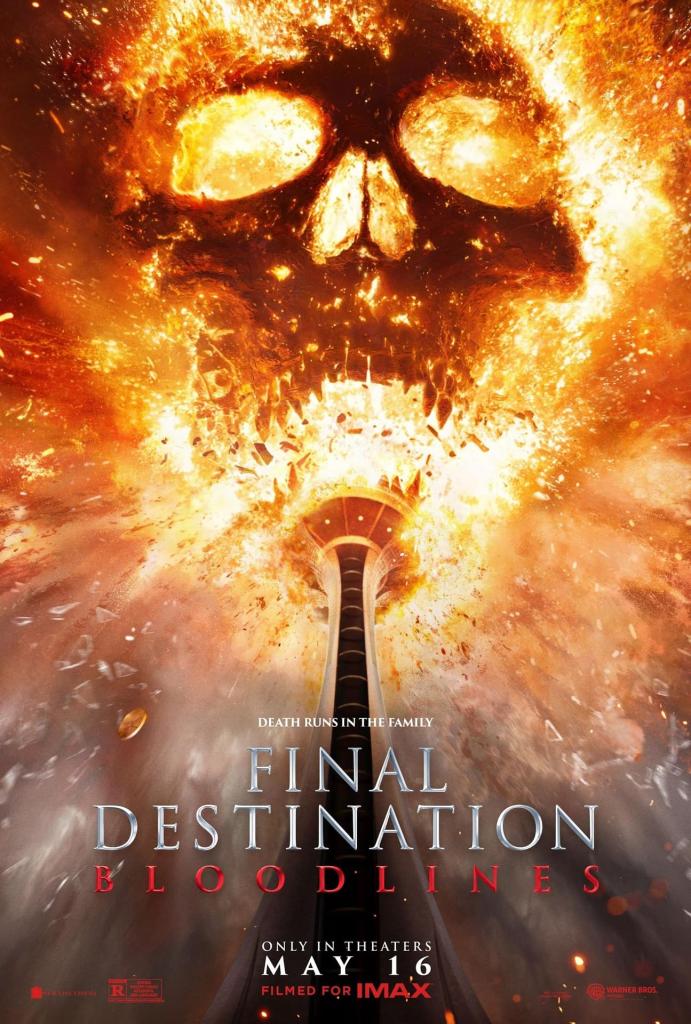
We finished off our month of spooky movies with the strongest entry in the franchise to date. It ticks all the boxes and answers all of our questions, but is it still hamstrung by the franchise itself? Is there a ceiling for how good these movies can be?
Check out our review to find out.
https://CupOfTea.podbean.com/e/final-destination-bloodlines/
We also have a transcript of our podcast for those interested in reading our thoughts rather than listening.
Tim: Hello, and welcome to Cup of Tea’s spooky reviews. Boo. My name is Tim, and I’m joined, as always, by Michael.
Michael: Thanks for having me.
Tim: Thank you for joining me. Oh boy, Michael, we’ve done it. We’ve finished the Final Destination franchise.
Michael: Feels good to get done, uh, with this yet in October. Like- Yes … I feel like we, every October, we like kind of set out to watch kind of a set of movies, and we chose to watch these, and like- Mm-hmm
yeah, it feels good and-
Tim: Yeah …
Michael: we’re kind of ahead of, ahead of pacing. We got a little more of October left, so. We
Tim: do, yeah. We, uh-
Michael: I, uh, I know we’ll probably release this at later, but like it, it feels good to be like mid-month- Yeah … like done with these, and we… Like, we watched six movies. That’s, that’s a lot.
Tim: We did a good job. We did a good job. Michael, please give us your hot take on Final Destination Bloodlines. It’s not Final Destination 6.
Michael: Tim, this is absolutely my cup of tea. There’s so much that is working well in this, and we’re gonna talk about all of it, but what I love most about this is you can feel that this movie was made by people who love this franchise, and I just love that.
Like, it was just like, it was fun to see, like, and feel like the passion and the love for- Mm … like what this is and the understanding of what makes it awesome. That’s just what’s infectious. Like, I really love that about this. So yeah, what about you? What’s your hot take on this one?
Tim: Oh, this movie was absolutely my cup of tea.
It took all the right lessons from the previous movies. It was a true culmination of the five films that came previous, and it really wrapped up this whole franchise in a really nice, really beautiful way, um, that really, really worked for me. I know it’s weird to describe it as a beautiful movie, um, considering its genre.
Its
Michael: bloodiness,
Tim: yes. Its blood and guts, but there is a scene that really I found very moving and very effective, which we’ll talk about in a minute. But, uh, yeah, this is my cup of tea, 100%.
Michael: So Tim, give them a rundown. What’s it about?
Tim: Well, after five movies we’re finally mixing things up a little. Most of these movies start with a premonition, somebody saves a bunch of people from a natural disaster, and then they all get picked off one by one.
This film plays things a little bit differently. We now open with a disaster, and then we flash-forward, uh, many, many years in time, and a young woman in college begins having dreams about the vision that we just saw. And she goes on an investigation to uncover the mystery of what this dream means, how her family is tied to this disaster, and, and is Death coming for them all.
And I loved… I’m just gonna dive right in. Yeah, do it. I love the fact that they finally changed the franchise up a little bit, and they finally took a different approach to the same material that we have seen five times before. We don’t need another movie that follows the same beats, and this understands that, and it juices it, and it really twists things around in a fun way and in an interesting way.
And I love the fact that they turned this into, like, a whodunit or a mystery that they’re trying to solve. I really appreciated that.
Michael: The setup of this, Tim, is one example of many in this movie, like you just talked through, where the creators of this film understand the format really, really well. They invert it or change it in a really good way.
Tim: Mm-hmm.
Michael: But they don’t lose what made it awesome to begin with. Yeah.
Tim: Yep. They never lost sight.
Michael: And, and they never lose sight of that. And so, like, sometimes in an effort to change it, you know, you see filmmakers take big swings, and they kind of lose the plot a bit. Yeah. Here, not at all. It’s like, so rather than doing this premonition and then the disaster, and we have our cast of characters, it turns out that it was this, this young woman, it was her grandmother who had the vision.
Mm-hmm. And she saved everyone from this disaster, and it turns out Death has been killing its way through everyone who was supposed to have died. Mm-hmm. And now this family, which was never supposed to have existed-
Tim: Yeah …
Michael: is now marked for elimination. Mm-hmm. It is an incredibly cool inversion to the premise.
Yeah. Like, this family was never in an accident, they were never in a disaster. Mm-hmm. Yet they’re in the same mortal peril as everyone in the previous movies. We just got to it in a very interesting, fun, different way- Yeah … that, to your point, felt very much more like a paranormal investigation- Mm-hmm
than it did just, like, a straight-up, like, horror movie, you know? Yeah. And that’s, again, th- one of many examples in this film where we kind of flipped on its head-
Tim: Mm-hmm …
Michael: the way we got to something, but we got to the right thing- Yeah … because they understood what made this movie great.
Tim: Yeah, no, they, they invigorated this movie with a lot of energy, and a lot of suspense, and a lot of innovation by, like you just said, just making small changes that really added up to a lot.
And I’m gonna jump in really quickly with the deaths and the, the death scenes, which is, you know, what most people are here for. They’re here for the deaths. But what they did that was so smart and so well done is they gave us a couple of deaths that we’re expecting. You know, set up 50 different things, and then a person dies in a horrible way.
But then they gave us a couple of really nice twists where the tattoo parlor scene where we think we know what’s gonna happen, we think we know how this is gonna play out, and it doesn’t play out how we expected. Mm-hmm. But we still had a really nice tense scene that took its time to build up the slow tension, and did a really nice job with that.
And then there’s a following scene where they’re walking down the street, and there’s all these different i- you know, objects and items and, uh, events that could take place to kill somebody. And it happens, but not the way we expect, which is the fun of these movies. Yep. We’ve talked about this a bunch of times.
What’s so joyful about… joyful about watching people die. But what’s so fun about these movies is sitting with somebody and trying to outguess the movie, and have the movie, like, trick you every single time. And I love that. This is a smart movie. It’s a well-written movie. It’s a well-thought-out movie.
And like you said, these guys love this franchise, and that’s, that really shines through every, uh, frame of this movie.
Michael: So I wanna take us to the rules now, Tim, ’cause that we talk about in every movie. Yes. This does a great job of that. Like- Yeah … this is another moment where, uh, the grandmother- Mm-hmm … who was the one who thwarted the original disaster- Yeah
has dedicated her life to understanding Death.
Tim: Yes.
Michael: So
Tim: finally-
Michael: Finally we get somebody
Tim: who understands …
Michael: who understands. So when the wind blows, she has fortified her cabin, for example- Mm … and has wind chimes everywhere. Yeah. So she can hear the wind coming from Death. And she knows, and, like, she has this whole binder that she gives her granddaughter that has all of Death’s secrets- Mm
kind of, like, how Death likes to operate. And again, it’s like we’ve been longing for this kind of, like, elder character who can like- Yeah … teach the cast, like, the ways of Death.
Tim: Mm-hmm.
Michael: And we finally have that here. Yeah. And it was really, really good, and it worked… It just, it worked really, really well for me, and I love that we, like, didn’t have to necessarily go through the characters discovering all the rules, because they got to learn them from this mentor character- Yeah
like through this binder that she had put together. Absolutely. That worked really, really well for
Tim: me. Absolutely. We, in most of these movies, they sort of tease that Tony Todd is that guy who sort of knows things, but the way they’ve always written him is to be very vague. He doesn’t always give really strong structure.
And in this they really nail that. And I’m gonna shift to Tony Todd, ’cause- Yeah, we gotta talk
Michael: about
Tim: Tony Todd … Tony Todd, oh, Tony Todd was a great actor with one of the best voices of all time. And he’s back in this movie in his final, I believe his final film role. Final performance, yeah. His final performance, and, um, I’ll let you speak to some of the behind the scenes- Yeah
’cause I think you remember that better than I do. But his scene is so great. He, he delivers the rules, he delivers the menace that, that we’ve expected from him in this franchise, and then he delivers a really beautiful sort of dissertation on life and meaning of life and death, and running away from death, but, you know, and embracing life.
And, and it’s such a really touching moment, and I just found it really powerful and really lovely that they gave him this moment to shine. And as you looked it up beforehand, well, a lot of that dialogue was improvised.
Michael: Yeah, so Tony Todd passed at 69 due to cancer, and he knew when he was shooting this movie, uh, that he was sick.
And, and we talked during it, like it’s pretty evident. Like he had lost a lot of weight- Yeah … like you could tell he wasn’t doing well. Um, and- Mm-hmm … the directors literally, they gave him a couple things, but they kind of were like, “Hey, improv.” Like- Mm-hmm … and he spoke about life and its importance, and you don’t know how much time you have and all these things- Yeah, yeah
very authentically-
Tim: Mm-hmm …
Michael: from his own experience as he was facing his own death. And it was really powerful, and you could also tell that for all the actors on set with him-
Tim: Mm-hmm …
Michael: that they, like, understood the importance of what they were doing, and like what a- Yeah … seminal, like, character he was in the- Geez
in the franchise. Um, so that was really, really incredible. Yeah. Um, so I, I really appreciated that, and I appreciate the, the director and the writer kind of just trusting him to get it right- Mm-hmm … and like allowing him that space. Yeah. Um, so that was really a powerful scene, especially knowing that behind-the-scenes context.
The
Tim: behind the scenes, yeah. And you can really tell. I mean, he’s very thin, and his voice does not have the same power. He, he’s able to pull it off for a couple lines where you really feel that power again, but you really feel the age, and you really feel that in those moments. And I honestly, I’m just a little choked up right now just thinking about the way he spoke about death.
It was really powerful, which is like we’re in this interesting media landscape now where these p- cheap horror franchises, cheap, you know, uh, uh, genres that were looked down upon for a long time are now getting elevated, and they’re getting, you know, serious attention. And this is a moment where what was a really cheap teen slasher style movie in 2000 is now being given serious writing, serious, you know, production value, and serious moments like giving Tony Todd this time and this platform just to- Mm-hmm
speak authentically to his experience, and I really appreciate that. I love the fact that he was able to do that, and s- and I mean, Tony Todd will b- always be one of the greats. So- Yeah … I’m very happy that he got to have that moment. I was so happy to see him come back for this movie.
Michael: And this isn’t… I’m gonna pivot off Tony Todd a little bit, but- Yeah
one of the things I loved about that scene was it, uh, uh, Tony Todd was obviously great, but it was our characters, and their mother was there too. And I was appreciating in this movie because it’s family focused- Yeah … it’s very intergenerational. Yeah. And one of the things we’ve talked about in pa- past reviews is I, I really like the movies where we have a lot of people at different life stages- Yes
in involved in the story. Mm-hmm. And this was very much that. We had people who were, you know, teenagers. We had parents. We had the grandmother, like obviously Tony Todd. Mm-hmm. Like, you know, so just everyone at different phase- Everyone at different phases of their life And that really worked for me. Yeah.
I like, I like it when there’s different perspectives in the room- Mm-hmm … because people are at different stages of life.
Tim: Yeah. What’s honestly kind of funny is if you and I had made a checklist of all the things we wanted to see- Right … from these movies, this movie systematically checked off every single one.
I was like, “Man, I would like to see more character development.” Check, we got the whole family dynamic and every character, every family member gets their own moment. You said, “Oh, I wanna see a scene where everybody is in the room together, and we get to really establish who’s, you know, who’s de- who’s going to die and in what order.”
Check, they did that perfectly.
Michael: I remember we were watching that, and gr- the granddaughter is presenting her grandmother’s work, and the camera starts with just one person in frame- Yeah … and I’m like, “Okay.” And then it pans, and you see everyone is there. And you and I literally were like, “Oh, whole family’s there.
That’s awesome. I love that.” Yes. And like, it was literally like, yeah, in real time being like, “Oh, box checked. Thank you.”
Tim: Exactly. I wanna make sure that we spend some time developing the tension and the s- and the stakes of each scene. Oh, yeah, you’re gonna take your time. This is, this is the longest movie in the franchise.
It was like two hours, a little over two hours. Two hours, two
Michael: hours, yeah.
Tim: Typically, these are an hour and a half. They spent the time developing the characters. They spent the time developing the tension of each, of each kill. And then they really went for it with the kills, which is awesome. All these elements really played really well.
Death obeyed the laws of physics in order to, to make these things happen. Yeah. All the… They systematically checked every single box, and they really, really nailed it.
Michael: I’ll, I got one more positive for us, Tim- Okay … that I just wanna call out, which is the initial premonition disaster thing-
Tim: Yeah …
Michael: was really scary to me.
Tim: Yeah,
Michael: yeah. Oh, yeah, great setup. Um, they’re in, like, a Space Needle kind of thing. Mm-hmm. Like a s- like a circular restaurant, like at the top of a space needle. One staircase down, one elevator down. Yes. And I… Like, that just might be, like, a me thing, but, like, I find that so terrifying. Mm-hmm. And in the premonition, of course, the, the stairs are gone.
Mm-hmm. The elevator’s gone, and our heroes are, like, stranded at the top of this tower- Yeah … and it’s like, “Oh, you’re done.” Like-
Tim: Yes. …
Michael: you know? Like, there, there is no-
Tim: Yeah …
Michael: you’re done, you know? Yep. And I just like, I find that so scary. Yeah. So I, I, I love that even in movie six- Yeah … we were able to find some kind of set piece that was, like- Mm-hmm
believable-
Tim: Mm-hmm …
Michael: but also super scary. Yeah,
Tim: yeah.
Michael: So, uh, so yeah, I like that a lot.
Tim: 100%. They did a lot of great setups, and that, yeah, that whole Space Needle or whatever it was- Whatever it was … Sky Restaurant thing. Probably
Michael: can’t call it that due to copyright. I
Tim: was just… That’s why, that’s why I, like, backed off.
We’re
Michael: gonna get sued now.
Tim: Oh, we’re, we’re in for it now.
Michael: The Space Needle people are coming after us.
Tim: The whole town of Seattle is coming after us, Michael. No, no, but the whole Sky Restaurant thing is such a great set piece, and they did such a nice job of slowly building up the tension and setting all these things up.
And yeah, there’s, there’s just the right amount of, like, cheeky winking at the audience of like, “Hey, you know this is about to go wrong,” that I really appreciate. So the movie’s got a, ni- enough of a sense of humor about itself. It’s got enough tension, enough scares, enough of the horror that I really appreciated it.
Michael: One… Okay, sorry, one other positive- Yeah … and then we can get off this, is- and start talking about a couple things that didn’t work.
Tim: Yeah.
Michael: Um, another kind of behind-the-scenes thing that I found out after we watched, I looked up, was, um, the director is, was basically like said to the crew, like, “I know you all are fans of this.
Do whatever you want.” Yeah. Like, Easter egg away. So, like the props team, like has like the Flight 180 on like a license plate. And like- Mm … you know, like there’s like a sign, or like, like there’s, um, there’s a truck that almost hits one of the characters, and it says Red Herring Inc. Yeah. You know? So it’s like- I love that the director was just literally…
And he was like, “I don’t need to approve anything. Just like do whatever you want.” Yeah. And like, and just trusted the crew.
Tim: Mm-hmm.
Michael: And they ended up coming with like a bunch of like really like fun little Easter eggy things. And it’s like, it’s cool when like, again, you got people who love and are passionate about the franchise, and then you just like let them just like put their passion on display.
So that was really cool. So Tim, what didn’t work here?
Tim: My biggest complaint is honestly the twist ending, which I don’t… Spoiler alert, there’s a twist ending, which all of these movies have, so it’s not really a spoiler. If you’re, if you’ve seen these movies, you know that there’s gonna be a twist at the end.
But it really didn’t work for me because, again, it sort of cheapens the journey that these characters have gone on of fighting death and, and, and trying to overcome these, these, you know, u- utilize the rules to their advantage and overcome death. I love that we spent this journey with these characters, and then for that ending to happen just felt cheap to me.
I understand, like that that’s the genre, it’s the convention, it’s the franchise, but it still felt cheap to me to, to see that, the final five minutes. So I would, like I would just stop the movie five minutes before the end, honestly.
Michael: We continue to have a problem in these movies that, like they just don’t know quite how to end them.
Yeah. Like, it’s like, and, or maybe they do, and I just am dissatisfied by it, right? Yeah, yeah. Like, it’s like everyone ends basically with everyone dying. Yes. And like, but it’s like- It’s sort of a
Tim: nihilistic ending,
Michael: which I don’t love … Yeah, it’s very nihilistic. And it’s like, it’s like each movie I like somehow build up the optimism to hope, and then like it doesn’t work out.
So like, maybe that’s on me. I don’t know. Yeah, it would… But, but I think, uh, uh, to be more serious about it, like if the characters are all gonna die no matter what, then there’s no point in doing the movie.
Tim: Yeah. That’s my feeling.
Michael: And so like the fact that they kind of like bait the idea that there’s like hope and like a chance to get out of it- Yeah
and then they never let it happen- Okay. Yeah. Like, it just, it feels a little flat.
Tim: Was there anything that didn’t work for you, Michael?
Michael: For me, beyond the ending, was there was one scene where, uh, we think this character is gonna die in the tattoo parlor, and he doesn’t. Yeah. Great bait. Mm-hmm. Love that.
Tim: Yeah.
Michael: Then we go and- Oh … his, like, younger sister dies.
Tim: Yeah.
Michael: And it’s, like, very unexpected. Like, and in, in fact, I didn’t even really, like, enjoy the kill because I was so convinced it was, like, a red herring. It was not
Tim: gonna
Michael: happen. Like, I was like, “Well, it doesn’t make sense. She’s not next in the order.”
Tim: Yeah.
Michael: Then she does die. Yeah. And so our character’s like, “Oh, no, I got the order wrong.” And I literally remember turning to you, being like- Yeah … “They better have a great explanation for this, and if it’s, like, Mom had, like, an affair, I’m gonna be pissed.” And then sure enough, the scene’s like, “Well, Eric, my oldest son, you’re actually not- Mm.
Yeah … biologically related to this family.” “I had an
Tim: affair.”
Michael: And I, and, and I was like, “Aah.” Like- Yeah … it just felt l- It was the cheapest … like, in the, in a movie of good writing- Yeah … it just felt beneath them. Like, I was like- Yeah … what a stupid bait. Like, it just, like, didn’t have to be that way.
Tim: Yeah. Well, ’cause I think we both developed, like, a head canon of, of like, within, like, the 10 seconds between the scene and the next of, like, oh, there’s, like…
They could do this. They could do that. They could do this.
Michael: Yeah.
Tim: And then it was like, oh, no, it’s obviously the worst option. It’s
Michael: obviously the worst option, right?
Tim: And it’s so, it’s like a… And it’s more glaring because it’s a, it’s, like, the one misstep in an otherwise very tightly written story. Right.
Michael: He almost…
So Eric, the oldest son, almost dies in a tattoo parlor, and it’s like, oh, maybe, like, Death skipped him, or, like, you know. Yeah. It’s like, oh, this is interesting. Maybe there’s, like, a new rule of death that we don’t know. Mm-hmm. Like, what a great way to introduce it. Yeah. No.
Tim: No.
Michael: I, we’re not gonna do that. Nah.
So yeah, that was the only thing that- Yeah … that and the ending were the only thing that didn’t work. I actually thought this was great. And I love- No, this was tight. This was solid … I love the inversion to it being more of, like, this investigative, like, mystery feel. Yeah. Um, it just was such a breath of fresh air to the franchise.
Tim: 100%.
Michael: But incredibly, they managed to do that and not lose, like, what made the franchise a Final Destination movie. Yeah. Like, it felt like a Final Destination movie. Yeah. Just really well done, and as you said, it was such a culmination to Tony Todd’s arc- Mm-hmm … to the rules of death. It was great. Yeah. And honestly, and no one got on a plane-
at the end to Paris.
Tim: Yeah. Nope, there were no planes to Paris.
Michael: There were no planes to Paris. The ending was still s- dissatisfactory, but it could’ve been worse.
Tim: Yeah, no, but I, honestly, no, this was, this was a great time. It worked really, really well. I would still recommend shutting it off before the final 90 seconds or whatever, but like, no, this was a really good time.
This is a really, really good culmination, and I’m very happy that we stuck with this franchise even through the depths of awfulness that was number four. This is a really interesting arc as a franchise. Yeah,
Michael: I was gonna say that.
Tim: One was really good. Two was a little step down. Three was a big step down.
Four was the nether realm- Bottom of the barrel … of garbage. Yeah. Yeah. Five, big step up. Six, total culmination. And, like, that is not the arc you usually see in franchises. Right. And I was really glad that we stuck with it.
Michael: I just feel like most franchises you kinda do this, like, hit, miss, hit, miss thing- Yeah
where it’s like, you know, you have… Like, when we watch Bond, it was like, you know, you had some good ones, and then they would try something, and it was like, ah, it didn’t really work, but then they recalibrate- Yeah … and then they get back on the path. Mm-hmm. So it was like, you know, you never had, like, a stretch of, like, six bad ones or six good ones.
Yeah. Like, it was like, you know, you kinda have some ups and downs. So this was really interesting that, like, you had the inception of the franchise, which was a good idea. Mm-hmm. Progressively worse iterations of it until- Yeah … it truly bottoms out in unwatchable garbage. Mm-hmm. And then, like, passionate fans of the franchise basically, like, take the helm of these- Mm-hmm
and make five and six tw- 10 years apart, basically- Mm-hmm … more than that, and they end up both being very, very good because- Mm-hmm … they understood what made it good to begin with.
Tim: Yeah.
Michael: And, like- Mm-hmm … that was such an interesting journey. I just like, as I think about- Yeah … all the franchises we’ve watched, like, even, like, think about, like, Fast.
Tim: Yeah. You
Michael: know, the Fast and Furious movies. Like, Fast is a movie-
Tim: Yeah …
Michael: that, like, it starts kinda middle-
Tim: Mm-hmm
Michael: And you move to like really good in the middle of the series. Mm-hmm. And then it kind of goes way too far. Yeah. And then it like starts to dip again as it gets into this realm of absurdity. Yeah.
So like, you know, if you think of that as kind of like a bell curve, right? Mm-hmm. Like a inverted bell curve. Like, you know, this is like the opposite type of bell curve. Yeah. Like it’s like this started good, got bad, and then got great.
Tim: Yeah.
Michael: Which is just like a weird arc.
Tim: Yeah. But it generally got like great.
It’s not even- It generally got great … it’s not even that like we’ve, we got back to where we started. This is like we’ve surpassed where we started.
Michael: Yeah, I agree.
Tim: I would say that five and six are much better than number one. I
Michael: agree. I think they are much better.
Tim: I, I think that this… But that’s like, that’s never what, how these things go.
Like, that is just not how these franchises, how these franchises work. Like, you don’t get a massive leap in quality like this- Agreed … in the final, in the final installments. And obviously there’s another one coming out next year, 20- I know
Michael: they’re making another one. I- … 28 … which I’m like a little hesitant about- Yeah
’cause I feel like we kind of got everything like really clean. I
Tim: got everything I wanted out of that.
Michael: Yeah. Like that was the thing. I mean, I’ll be curious to
Tim: see- I felt very
Michael: satisfied … if they try to like break format again and like, you know, is it investigative? Is it like back to the original? Yeah. Do they try something new?
Like, if I’m an optimist here, I would say what the, what’s nice is like six charted a, a path forward that showed them there are other ways to do this.
Tim: Yeah.
Michael: So maybe the next creators are like, “Oh, I see that there’s like additional opportunity. Let’s go for it.”
Tim: Yeah.
Michael: So that could be really interesting. But I am like…
It just felt so cleanly tied. Yeah. Like I like, I like, I could be done here. Yeah. Like I’m definitely gonna watch seven, but like, you know. Yeah. Like, i- it’s like I could be done and it would be good.
Tim: Yeah.
Michael: Um, and okay Sam, I wanna hit you with one more question before we go. Yeah. Which we might very well cut out of this episode.
Tim: It’s all right.
Michael: Uh, we talked before about this idea of like 94% on Rotten Tomatoes for- Yeah … a movie like this versus like obviously like, you know, Citizen Kane. You know? Yeah. Uh, The Godfather. Yeah. You know, like these… Like a 94 for this movie versus that feels different.
Tim: Yeah.
Michael: Like h- how do you feel about these Rotten Tomatoes scores now that we kind of watched them ourselves?
Tim: Um, what’s interesting, we talked about this kind of off mic around the four, three or four or five range. Um, and I was like, “You know what? There’s really a ceiling for how good these movies can be”-
Michael: Yeah …
Tim: because they follow the same formula so closely. And honestly for this one, because they broke with that formula, they found a new way to sort of elevate and be much better than the movies that had come before.
Michael: Agreed.
Tim: So I genuinely think that these could, while they are still sort of, yeah, kind of hamstrung by the, the needs of the genre, like we’re still gonna have overly gross kills. We’re still gonna have people get run over by lawnmowers and, and exploded by MRI machines. So like it will only ever be that good.
But as, in terms of how good these can be, I am like redefining the ceiling-
Michael: Yeah …
Tim: um, because of this one. Like they really elevated everything. They brought it way up in terms of quality and- Like, I think a 94 now is, means a lot more to me than a 94 would in, in sort of the, the rote franchise formula that we’ve seen before.
Yeah. So I would definitely, I would definitely say that, that yeah, like the… It’s, I mean, no, but it’s never gonna be Citizen Kane, but it’s elevated this, this franchise and this, like, type of genre in a way I wasn’t expecting.
Michael: Yeah. I agree with that 100%.
Tim: When would you recommend number six? And then we’ll talk about the franchise as a whole.
Michael: Uh, six was great. I definitely recommend it. Honestly, like, I, I… It was my favorite movie of the entire- Yeah … of the whole series, honestly. Yeah. I agree with that. Like, if I were… Well, we’re gonna talk about the franchise in a second, but, like, I, this is definitely my favorite. Like, I, I would highly recommend this.
This was awesome.
Tim: Now, would you recommend it if they haven’t seen the other films in the franchise?
Michael: No
Tim: Yeah. No I mean, that’s, that’s what I’m thinking. Like, this is still great, but you do need the backstory, and you need at least one, two, and five to really, I think, make this stuff- I
Michael: think you could watch six and get it.
Tim: Yeah.
Michael: But I think to be a 94% on Rotten Tomatoes, you have to have at least a couple of the other movies under your belt.
Tim: And, yeah, right.
Michael: Yeah. Okay, so what’s your ordering quality-wise? My ordering quality? Order, yeah. Hmm So best to worst.
Tim: Best-
Michael: Actually do worst to best. Let’s build to the good.
Tim: Uh, I mean, four is obviously the worst.
Four
Michael: is trash, yeah. Trash Definitely the worst.
Tim: Unwatchable.
Michael: Unwatchable. Literally
Tim: delete. Yeah, delete. Three is next.
Michael: Yeah,
Tim: I agree. Very, like, not great, but-
Michael: Yeah …
Tim: you know, if, if fi- if four is an F, then three is a D. Yeah You know?
Michael: Yep.
Tim: Um, I probably-
Michael: I’m curious about your two, one, and five ’cause this is where I think, like, kind of like the three movies are floating.
I’ll be curious- Yeah … to see how you rank these here.
Tim: I’d probably put two next, but if three is a D, then two is, like, a B or B-minus. And then I would put one-
Michael: Mm-hmm …
Tim: probably at, like, a B, B-plus. Five is, like, a B-plus, A-minus. And then, uh, number six, Bloodlines, is top of the class.
Michael: Yeah. Uh-
Tim: I mean, do you…
Does that track with you?
Michael: Yeah, I’d probably agree with that. If I were gonna be contrarian on one point- Yeah … which I’m not. I actually think you got, like, the right. But if I were- Of
Tim: course I’m right …
Michael: the one thing I really liked about two over one was whoever the director was, I forget who it was, he was, like, a…
He did, um, a bunch of stunt work. He had done, like-
Tim: Oh, that’s right.
Michael: Yeah And I really liked the opening disaster in two. Like, I thought it was awesome. Yeah Like, it was so much better than one. It was so much better than one. Like, one was, like, low-budget plane explosion.
Tim: Yeah.
Michael: This was, like, that log thing on the highway.
And, like, I was just… I remember sitting back in my chair and just being like, “This is crazy awesome.” Yeah. Like, this feels like I’m in an action movie. Um-
Tim: The
Michael: visceral experience of those, yeah … the visceral experience of the, um, the disaster in two. I think one was overall a better movie. Like- Yeah … if you remove, like, the premonition, which is literally amnesia and doesn’t happen- Yeah
so doesn’t count. Um- Yeah … one I think is a better film, but, like, two, the opening disaster set piece is insane.
Tim: Yeah.
Michael: And, like, I guess, like, if I were to flip anything, that would be the one flip I’d make, is, like, I know one’s the originator, so you have to give it some credit for that, but, like-
Tim: I could definitely see two over one.
I think, like- Yeah …
Michael: I
Tim: could definitely
Michael: see that. Two over one would be… But, like, I think it’s so much of that is carried on the back of the-
Tim: Yeah …
Michael: initial set piece, which is incredibly good in two.
Tim: Yeah.
Michael: Very visceral, very real. Um- Yeah, very good, very real. And like, one obviously doesn’t have that, though I think one again, again, it sets the franchise up.
I mean, there’s so much to it. Mm-hmm, yeah
Tim: But- And I think one has a lot of good character stuff, a lot of good world building, a lot of good… A lot of good is happening in number one. Um, but dude, it is hard to argue with the visceral impact of, of number two. So-
Michael: Yeah, the, the opening intro. And they, and they do the good job of getting everyone in the room in two.
Yeah. Like, you start with the everyone in the room thing.
Tim: Yep. Mm-hmm.
Michael: Like, two had a lot of things that it did well.
Tim: Yeah.
Michael: Um, but the characters weren’t as strong I feel like. Yeah. Like, in one the characters were better. Um- Two
Tim: is also the only one that ends positively.
Michael: Right.
Tim: Or, or, you know- Or semi-positively, yeah
it’s not like positively. It’s not like a happy ending, but like, it doesn’t have the ch- the fake-out that all, every other movie in the franchise does.
Michael: Yeah.
Tim: And- And I do really appreciate that. I do think we need, I need that personally as a viewer. Yeah
Michael: So. And two also, um, spent a fair amount of time on the connectivity to one.
Like, we had- Yeah … Clear River like come back- Yeah, that was good, yeah … and like, um, which- It worked in some places and it didn’t work in others. And like, but like, yeah, it was, it was, I don’t know, 2 just felt so connected to 1. Yeah. It’s like almost hard like to be like, “2’s better than 1.” Yeah. It’s like they’re, you know- Hard to separate
Tim: them.
Michael: Yeah, yeah. It’s hard to separate. So either way. But no, I, I think that’s a great, a, a great list. I would, uh- Like, you know when you hear about how, uh, movies that were made in like the 1910s and ’20s, they often like lose the reel for? And it’s like a sad thing.
Tim: Yeah, yeah.
Michael: If they lost the reel for 4- Like-
Tim: If somebody accidentally deleted all the digital files- Like-
off the hard drive …
Michael: five. Like-
Tim: Would not miss it …
Michael: be like, “Oh, no, you can never watch 4 again.” It’s like- Oh, no … thank you for doing a public service- … tech guy. Like, you know, so.
Tim: Right? Oh my goodness.
Michael: But no, I, I’m really glad we watched this, man. This was cool. Yeah. And I feel like this was, um, I guess I’ll close by saying I think this is like, as I think about like our intersections in terms of this like genre, like I very much enjoyed these movies.
Yeah. Like, and like I don’t necessarily love, like being scared off, off my butt, uh, in these movies. Yeah. Um, I wasn’t necessarily like terrified of these movies. It was more- No … like, it, it, puzzle-solving. Yeah. Like, you know, the, it was fun. It was fun. Like the, yes, it’s gory, like I wouldn’t show this to everybody in my life.
Yeah. But like, I felt like this was a fun, like intersection, where like, uh, like you as a huge fan of these movies, like I enjoyed them and, and found, but I also found some things to hang my hat on, too, even though, like some of the gore and stuff, like freaks me out, and like I’m not, not super into that.
Yeah. But, uh, but yeah, so I, I really liked these. It was kind of a perfect franchise for- It was a, it
Tim: was a really good- …
Michael: Halloween …
Tim: yeah. A really good marriage of, of what you’re willing to tolerate and what I like.
Michael: Yeah.
Tim: Um, because- You
Michael: were willing to narrate to me what was happening on screen in the multiple times that I turned around and was like, “Oh, God.
Oh, God.” Because they were, and that’s what was great about these movies. Like, um- Yeah … there were moments where, uh, like when his hand is in the garbage disposal- Oh, geez. Yeah … which ends up being like a, a bait.
Tim: Mm-hmm.
Michael: But like, I was like, “Oh, no. Absolutely not. I do not do hand shit.” Like, that is like, I, oh my God, that was so bad.
And then the nail on the gymnastics beam was another one- Oh, that was brutal … that I just could not watch. Like I was- Yeah … just like, “No, can’t watch.”
Tim: Yep. Yep. “
Michael: This is too bad.” Yeah. And that was great, ’cause it was such a bait. Like- Yeah, right … they just like totally got you.
Tim: Yeah.
Michael: But yeah, this was like such a fun intersection- Mm-hmm
of like- Well, it’s- Yeah …
Tim: of what I’ve said throughout the series is like, well, when these work best, it’s that they understand that it is a suspenseful-
Michael: Yes, it’s about
Tim: the suspense … tension-filled thriller. It’s not about-
Michael: And that’s what 4 missed. Yeah. Is 4 made it about the gore.
Tim: 4 made it about the gore, and made it about like the special effects, and made it about the 3D.
The 3D. Made it about like, yeah, just like showing off how people die. That’s not interesting. What’s interesting is the build-up, and you trying to outguess what’s gonna happen in the movie Yep And I think that’s where, that’s where this intersection worked really well for both of us. Like- Yeah,
Michael: I like that Yeah.
And that’s why I think VI worked really well, is like- Mm-hmm … it moved in this almost, like, less of a horror, like, generic horror movie, air quotes- Mm-hmm … and more of, like, a paranormal investigation movie- Yeah, yeah … like a mystery. And like, I, I just love that feel. So- Absolutely … no, this was great, man.
Tim: Yeah.
This was a good franchise. I’m really glad we watched these. I had not seen these before, so it was really fun to explore a, a, whatever, territory within the horror genre that I have not seen. So-
Michael: Yeah, I always love doing stuff that you haven’t seen before, ’cause y- especially in this genre, you’re prolific.
But- Mm … there is, it is, it is a fun experience to embark into the unknown.
Tim: Yeah. So I would definitely recommend the franchise if you, yeah, are gonna get together with some friends and try to outguess the movie. I 100% think that’s the right way to watch these movies. And again, only watch p- only watch I, II, V, and s- VI.
Skip III and IV.
Michael: Yeah, you could not do III and IV and it’d be fine.
Tim: Yeah. All right. Well, guys, thank you so much for joining us for spooky month. We look forward to, uh, talking about something a little lighter.
Michael: We’re gonna be doing our Christmas movies again this year
Tim: We are.
Michael: We are. Uh, so if you want a total vibe shift- Join us for Christmas movies
uh, we are gonna be… Join us for Christmas movies.
Tim: Uh- And if you have any recommendations for Christmas movies- Send them
Michael: our way. We’re building the list right now …
Tim: send them our way. Um, okay, caveats, we’ve already seen the classics. We don’t need the classics. We’re looking for, like, Holly- We’ve
Michael: already seen all the Lawrence brothers movies-
so we don’t need any Lawrence brothers films.
Tim: We’re looking for, yeah, kinda hallmark. We’re looking for off the beaten path. We’re looking for weird Christmas movies. Um, whatever you’ve got in that, in that arena, that’s what we’re looking for.
Michael: I’m ready.
Tim: All right, hit us with those recommendations. Thank you guys so much for listening to Cup of Teas Spooky Reviews.


Leave a Reply