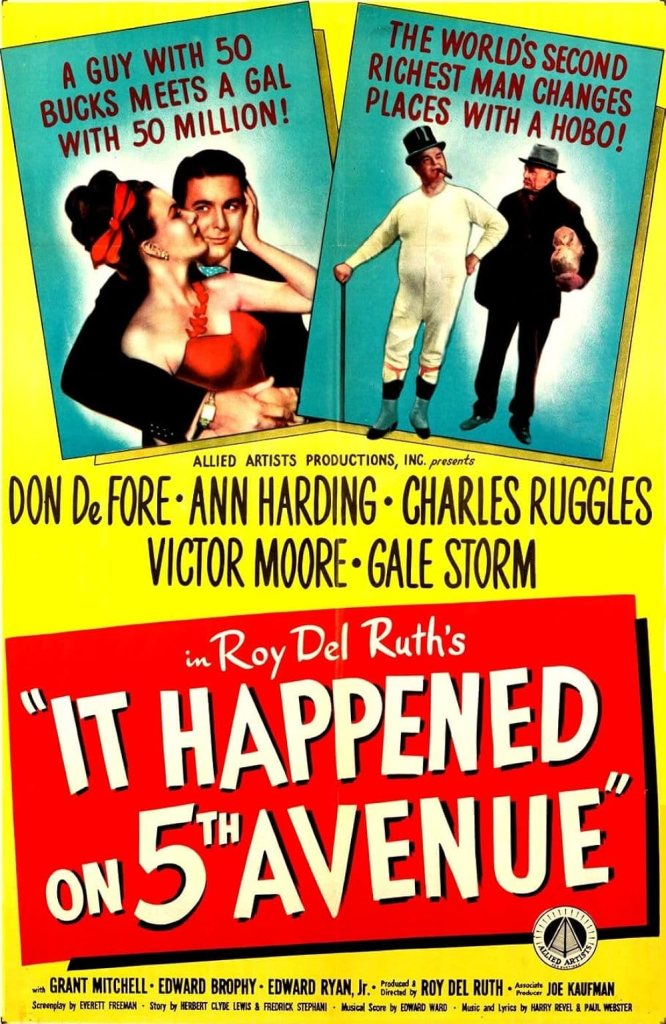
This delightful 1947 comedy has grown on me over the years. It’s good natured charm and warm heart adds the perfect for me every holiday season.
The film follows Aloysius T. McKeever, played by the charming Victor Moore. His voice is reminiscent of a squeaky staircase but in the most delightful way. He and his dog Sam own no home, but have the perfect solution, for years they have been living in the New York mansion of the second richest man in the world Michael J. O’Connor. O’Connor spends his winters at his Viriginia estate, so when O’Connor moves out of his New York house, McKeever moves in. When O’Connor returns to New York in spring, McKeever heads down to Virginia. It works well until one winter when McKeever meets a homeless veteran named Jim Bullock and invites him to stay in O’Connor’s mansion too. Pretty soon McKeever is hosting a whole host of people including O’Connor disguised as a homeless man.
The film was originally intended for Frank Capra, and you can see his particular touch in certain elements of the film. It has the common man angle. The coming together of friends in hard times, and the transformation of conceited wealthy man who realizes there are more important things in life than the pursuit of wealth. However Frank Capra decided to direct It’s a Wonderful Life instead, and I for one am very happy with that decision.
This film is delightful and charming with real character arcs and a social conscience that elevates it from a lot of holiday faire. At the time of the film’s release WWII had ended and the soldiers coming home were finding a different country than the one they left. One big problem they were facing was housing. According to the National WWII Museum, between September and December of 1945, when the film was being written, the United States army discharged an average of 1.2 million men per month. How do you find a house when 4 million other men are looking for a house? Where do you find a job? These questions are top of mind for the movie, and the film puts a human touch on a very real problem people were facing at the time.
Jim Bullock and his two army buddies along with their families are trying to build lives for themselves, but are coming up against the massive industrialist O’Connor. He is snatching up what little properties remain in order to expand his empire. The movie really begins cooking when O’Connor moves back into his house by pretending to be impoverished. He and McKeever have a delightfuly antagonistic relationship with McKeever pushing all of O’Connor’s buttons and humbling him the process.
One thing I love about the movie and most movies from this time period are that they don’t adhere to a strict plot structure. These days everything feels so rote and paint by numbers. Movies from this time period were free to play with form and function. The movie begins as McKeever’s story. It adds Jim and the veterans story. It adds O’Connor and his humbling transformation. It doesn’t feel like too many cooks in the kitchen or too scattered. It all just adds up to a very full and very fun story.
It’s also completely implausible. I mean the idea that this man lives in the big mansion unnoticed and by the end the millionaire is so warmed that he is going to invite the man back next year is pretty sappy and vaguely ludicrous. But I love it. It’s a fantasy, and I buy it every single time I see it. It makes me happy to spend an hour and a half with these characters in this particular fantasy that happens to be grounded in reality.
It’s so satifying and so charming and so good natured. It warms my heart every time I watch it. It’s not the best Christmas movie out there, but it is just too sweat to ignore. It’s totaly my cup of tea. A
 Cup of Tea Reviews
Leave a comment